English Language Support

Language proficiency, reading speed and comprehension, vocabulary, and typing all play a role in successful CPA studies.

Language Proficiency

CPA Canada uses language benchmarking to determine the English proficiency recommended for the CPA Professional Education Program.

The CPA Western School of Business language recommendations for participation in CPA education programs mirror the benchmarks set out by CPA Canada.

In Canada, English language skills are evaluated according to the Canadian English Language Benchmark (CLB), which gauges the level of English proficiency on a scale of 1-12. To enter and successfully participate in and complete the CPA certification program, a minimum level of CLB 8 or higher is recommended. If you have not had an official assessment of your English language skills and would like to determine your CLB benchmark, there are proficiency exams you can explore.

The Government of Canada website provides information regarding the types of proficiency exams available and how they correspond with the CLB. The CELPIP and the IELTS exams are the main exams used for immigration, residency, and admission to post-secondary education.

Before deciding to spend money on an official test, you can visit these free resources to test your writing, listening, and reading skills:

Speed Reading

When you were learning to read, saying the words, numbers, and symbols in your mind as you read them may have helped you. However, if you are enrolled in CPA Education programs and courses, you want your eyes to track the words you read quickly. The faster you read and understand what you’ve read, the faster you move through course materials.

There are plenty of free resources available online to test your reading skills for speed and comprehension. By taking these tests, you will also see how much you’ve understood from what you read.

Here are some online websites to test your reading speed:

  • Readingsoft.com to test reading speed and comprehension. It is important to note that screen reading is approximately 25 percent slower than paper reading.
  • Readspeeder.com course for faster reading and improved comprehension

With Readspeeder.com, you can develop your reading skills through a series of lessons that focus on reading comprehension. Explore concepts such as words vs. ideas, chunks vs. phrases, visualizing, and concentration, and track your progression from your baseline to your current reading speed and the percentage of improvement. You can also set the maximum number of words to appear while reading, as well as compare reading speeds, time your reading, and match images with phrases using PhraseFlash.

Here are some online websites to test your reading speed:

Building Vocabulary

It can be a challenge to read in a language other than your first language. However, it can become easier if you prepare in advance. The larger your vocabulary—especially specific to your chosen profession—the more comfortable you will feel when navigating through your modules and exams.

Quizlet.com offers flashcards for accounting terms from basic to advanced level vocabulary.

The following resources provide vocabulary related to accounting:

Language Resources

Available through the Provincial CPA Body websites

Each Western provincial CPA body has English-language resources on its website that you may find helpful.

EAL Resources

Western Region Public Library, Post-Secondary, and Government 

In your communities, you can also take advantage of public library, post-secondary, and provincial government resources. Each Western province provides EAL learners with a variety of EAL building opportunities to assist you in becoming more confident in your English abilities.

Keyboarding

How fast and accurate is your typing? Developing a wide range of vocabulary, combined with increased reading and comprehension speed, can help with typing accurately. 

Typing with accuracy involves having a high level of hand-eye coordination. When under pressure, motor muscle movements become slower or more erratic. This feeling is amplified if you are used to working with a non-English keyboard and suddenly switch to an English keyboard.

You will benefit by practising to type your responses quickly, especially under exam-like conditions. Learn the placement of the alphanumeric symbols on your English keyboard so you feel comfortable using them effortlessly.

Resources to test your typing speed:

Typingstudy.com

Test your current typing speed and accuracy using an English keyboard. You can also complete key drills, lessons, and complete typing tests to gauge the improvement of your typing abilities.

Typing.com

You will find quick and efficient typing drills that provide a measure of your speed and accuracy according to the time taken to complete them. Explore different levels of typing to improve your speed and coordination.

Keybr.com

Practice typing consonant and vowel combinations that appear in the English Language. Build your typing speed and track your progress through a stats generator.
The CPA Canada Learning Library: Enabling Competencies Volume

The CPA Canada Learning Library: Enabling Competencies Volume includes learning resources to help candidates apply the CPA Way methodical approach to addressing professional problems and approaching CPA PEP studies and examinations using professional writing skills. This resource can be found within the Introduction to the PEP Desire2Learn (D2L) module in a candidate's D2L account.

Using Professional Writing Skills

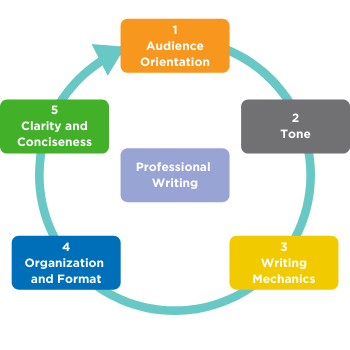
How you express your writing skills will determine whether you have exemplified professionalism. According to The CPA Way and the CPA enabling competencies, you can achieve professional communication by considering these five attributes below.  

For more information on applying the CPA Way methodical approach and professional writing, please visit the CPA Canada Learning Library: Enabling Competencies Volume, Chapters 18-24 for further examples and scenarios.

To see an example of professional writing skills applying the CPA Way, please refer to the CPA Canada website for a sample report of a past Capstone 1 case.

PROF_Writing

Consider your audience. What knowledge do they have about the subject of your communication? How will you tailor your response to their needs? What is your role and what are you trying to achieve?

Audience Analysis Overview

The CPA Mindset is the first part of The CPA Way and demonstrates the attitudes and behaviours of a CPA. Communicating with a professional tone conveys respect, courtesy, sincerity, objectivity, integrity, and fairness in written documents such as emails, memos, and reports. Is the attitude you are expressing aligned with the CPA Mindset and appropriate to your given role and the audience? 

Tone in Business Writing

Professional written communication adheres to proper writing mechanics. How well do you follow the rules of writing conventions? Examples: punctuation, sentence structure, spelling, capitalization, and quotations. 

Do you organize your information and arrange it to fit the type of communication you are using for reports, emails, memos, presentations, etc.?

Conciseness and clarity provide the audience with the right amount of information needed for their understanding. How clear and precise is your communication while remaining supported?