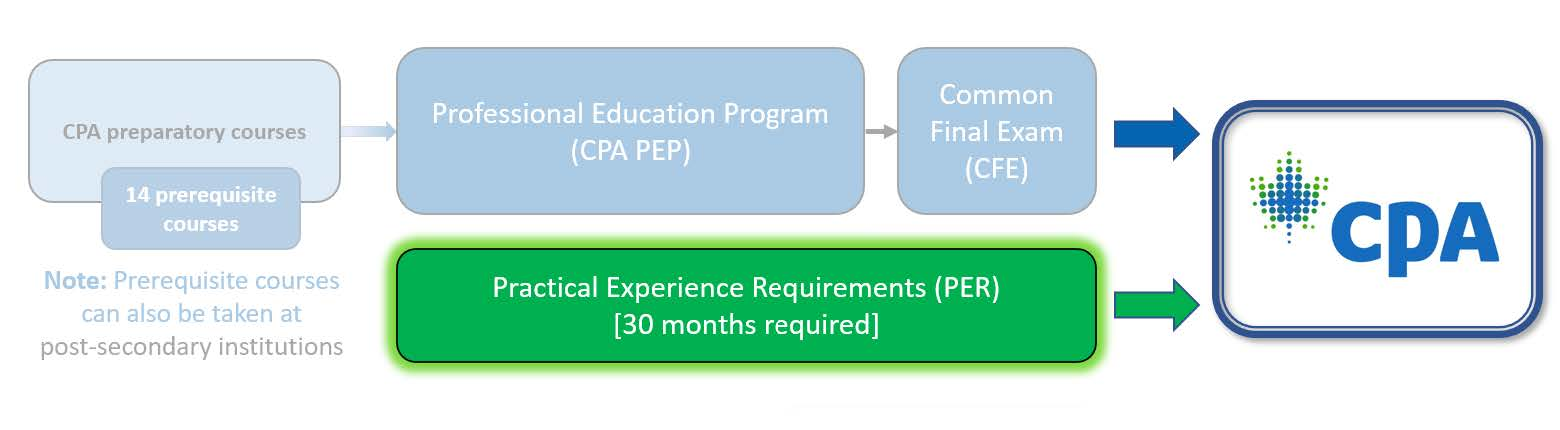
In addition to completing CPA PEP and the Common Final Examination (CFE), the CPA practical experience requirement is also a critical component of the CPA certification program. The knowledge and competencies gained through practical experience complement those developed through education.
Note: Practical experience is administered by the provincial CPA bodies, which can assist you with questions about practical experience reporting.
Types of Routes to Practical Experience
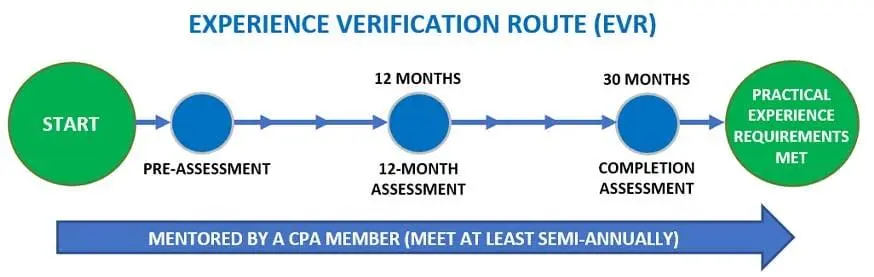
Future CPAs can gain experience through either route or a combination of both. You can only begin recording your practical experience after securing a CPA mentor.
The Experience Verification Route provides flexibility in your role but requires more reporting. You choose the employer, provided the role allows you to demonstrate competencies and gain relevant practical experience. Future CPAs complete detailed experience reports in PERT that are reviewed by the profession at key milestones. Supervisors verify and attest to the accuracy of experience reports.
Candidates in this route must report to the profession based on the timelines provided to them in their last CPA review.
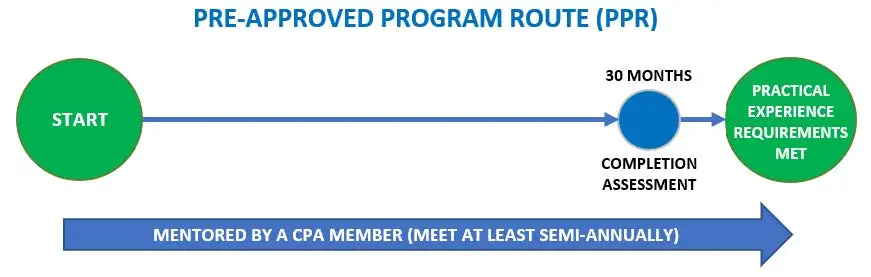
Pre-approved programs are training positions that have been approved by the CPA profession in advance and are designed for you to meet the practical experience requirements within 30 months. As a result, less documentation in PERT is required from future CPAs taking this path. Review by the profession occurs when you complete the program. Qualifying experience for the audit and review (where applicable) streams of public accounting can be gained only through the pre-approved programs.
Candidates in this route should continue to report their experience and request a CPA review once they have completed their experience requirements or if they change jobs.
Practical Experience Requirement
There are five common requirements that all candidates must meet regardless of their chosen route.
For assistance with your overall practical experience journey, you must contact your provincial CPA body directly.
The period of practical experience cannot begin until you have a CPA mentor. The mentor must be a CPA in good standing, or a designated member in good standing with a recognized professional accounting body. The mentor must register with the provincial CPA body before commencing their mentorship of the candidate.
You must meet and discuss your progress with your CPA mentor at least semi-annually. The mentor provides guidance on your competency development as a CPA candidate and models and facilitates the development of the profession’s values, ethics, and attitudes.
Find a CPA Mentor
The process by which candidates are matched with a mentor depends on their chosen route:
- CPA Pre-approved Program: Candidates are matched with a CPA mentor by the organization offering the program.
- Experience Verification: Candidates seek out their own CPA mentor to find a successful fit. There are supportive networking resources available to help match candidates with CPA mentors if they are unsuccessful in finding a mentor.
Your supervisor is the person to whom you report. Your supervisor is responsible for either assigning you the required experience in a pre-approved program or, within the experience verification route, verifying that your experience is factually accurate in your experience report.
Your supervisor does not need to be a designated accountant. Supervisors who meet the mentor criteria can perform the roles of supervisor and mentor for the candidate.
A minimum total of 30 months of practical experience is required, consisting of relevant paid employment that is progressively challenging for the future CPA to develop as a professional accountant.
Are you someone looking to report experience completed in the past?
Prior experience of a minimum of 3 months to a maximum of 12 months may be recognized as qualifying practical experience towards the total 30-month minimum that is required. To ensure experience is relevant, all experience must be gained in positions that ended within the last 7 years. In assessing prior experience, final approval is at the discretion of the provincial body.
If you are unsure whether your past experience, current role, or a prospective one is relevant for the CPA Practical Experience Requirements, you can use the Practical Experience Self-Assessment Tool to approximate whether or not it will be usable.
Your experience report should include:
- the duration of the experience,
- the type of your current experience, and
- your self-assessment of these experiences.
Your gained experience is self-assessed at least twice a year and discussed with your CPA mentor.
Practical Experience Competencies
You must develop breadth and depth of technical competencies and development of enabling competencies as per the CPA Competency Map.
| Technical Competencies | Enabling Competencies |
| 1. Financial Reporting | 1. Acting Ethically and Demonstrating Professional Values |
| 2. Management Accounting | 2. Solving Problems and Adding Value |
| 3. Strategy and Governance | 3. Communicating |
| 4. Taxation | 4. Managing Self |
| 5. Finance | 5. Collaborating and Leading |
| 6. Audit and Assurance |
At key milestones, the experience report must be reviewed by the profession (CPA provincial body). Domestic or international experience may be recognized.
There may be exceptions for CPA candidates developing an area of depth in a standards-based competency area, and chargeable hour requirements for CPA candidates pursuing public accounting.

Looking to transition your experience to the new CPA Professional Program?
If you do not have enough time to complete the CPA PEP program, then you may transition your experience to the new program.